United in Celebrating Resilience through Freedom

Today we gather to celebrate Emancipendence, and our theme is: United in Celebrating Resilience through Freedom. Once again, we are called to consider where we are as a people and to remind ourselves who we are and how far we have come.

The theme for this year’s Independence is United in Celebrating Resilience and since emancipation is always about freedom, I have extended it for our reflection to be ‘United in Celebrating Resilience through Freedom.’

We need to have a common understanding of resilience, Freedom Independence and Emancipation. I recognize that none of these situations is a onetime act. They may begin as a single act but each of them consists of ongoing activities to maintain them. Resilience is the ability to keep going through difficult times, adapting oneself and eventually rising from adversity. The word has the same roots as resurrection.

Independence defined by the Merriam Webster dictionary means, freedom from outside control, support, or influence. It is the state of running your own life, country, or finances by yourself. But that never quite happens, because external forces, always intervene. These intervening forces, Paul refers to as principalities and powers. Independence is therefore a misleading term, because it is never fully achieved as we have to compromise and adjust to accommodate others.

Emancipation which is where I would like to focus our thoughts today, is the act of setting someone free from the control, power, or legal authority of another person, group, or system. It brings liberty, own choices and equal rights where control or bondage once existed.
Freedom is the power or right to speak, act, and make choices without causing cruelty, control, or slavery. It is Being able to make choices and taking an action of your own choosing. Freedom will always be relative to the situation in which you are.

Freedom is something we should never take for granted. For many of us, freedom can seem like an ordinary part of life. We wake up, go where we want to go, choose what we want to do, and make decisions about our lives. But not so for others, particularly the vulnerable among us, children the elderly, the sick, the abused. When we remember our history, we understand that freedom comes at a great cost.

Emancipation then is more than a date on the calendar. It is a reminder of where we have come from, what our ancestors endured, and it says to us there is a price that was paid, that is always being paid for the freedom we enjoy today. Galatians tells us that It is for freedom that Christ has set us free. It is for freedom that Christ has set us free. You and I are called to be free. The passage goes on to say we must not use our freedom to indulge the flesh; to abuse or keep back another, rather, serve one another humbly in love. Freedom is to be found in keeping this one command: “Love your neighbour as yourself.”

When we speak about emancipation in Jamaica, we remember generations of enslaved people who were brought here against their will, separated from their families and communities, stripped of their freedom and treated as property.

Yet, they, our forebears, refused to allow oppression to destroy their humanity. They worked. They prayed. They sang. They created families and relationships. They preserved traditions. They resisted injustice as best they could. They dreamed of freedom and they worked towards it. That freedom came through struggle, courage, sacrifice, faith and perseverance. And they survived, making them resilient. A trait we must adopt too.

Our reading from Deuteronomy 8 reminds us not to forget. Moses warns the people of Israel that when they enter the Promised Land and enjoy its blessings, they must remember that it was the Lord who brought them through their struggles. Implicit in this reminder is that they must understand who they are – that is their identity. They were Israelites and a wandering Armenian Abraham was their ancestor and God brought them out of bondage in Egypt. Memory comes through an understanding of what is important to keep. And we, we must not forget who we are, we must not forget the sacrifices that our ancestors made to bring us here, including the fathers of our Independence. Even while some may say forget about slavery. It is our roots. We must remember the plantations but without bitterness, but with a resolve, that we will not allow a similar thing to happen to others. We must remember that there are people, whose names were never recorded in history, but whose labour helped to build this nation.

To be free we must hold this memory dear to us. because when we take our freedom for granted, we make choices that do not help the common good. When we forget the struggle, we may fail to recognize injustice when it appears in a different form. Today we celebrate not just freedom from something, we celebrate freedom for something. Freedom to live with dignity. To serve. To love, to worship god, to build a more just and compassionate society.
When we forget the sacrifices of those who came before us, we may become careless with the opportunities they helped to create.

Celebrating Emancipation teaches us to Remember the past but not to live in the past, but to learn from it and to build a better future.

Psalm 146 reminds us that God is concerned about freedom and matches well with Luke 4:16-19 which I do believe is a passage of scripture if we are able we should know by heart. If not, we need to know the essence of it. It is a quote of Isaiah 61:1-3. It sentiments are recorded elsewhere. It speak about justice to the oppressed, giving food to the hungry, setting prisoners free, lifting up those who are bowed down and watching over the stranger and the vulnerable.
This means that the struggle for freedom is not foreign to the heart of God. God cares about human dignity.

God cares when people are oppressed. God cares when people are denied justice. God cares when the vulnerable are forgotten. As Christians, we cannot celebrate emancipation merely as a historical event. We celebrating freedom reflects something about God’s own character.

Because God is a God who brings people out of bondage. The spirit of God is within us which helps us to do the same. The Bible is filled with stories of God bringing people from slavery to freedom, from oppression to hope, from darkness to light.

And our Jamaican story is not any different. We are reminded that even in the darkest national or personal circumstances, the human spirit can continue to hope.
Our ancestors had little control over the conditions in which they found themselves, but they refused to surrender their hope. They made the culture we now revere. Our music, language, food, traditions and indigenous forms of worship.

They found ways to maintain their dignity in a system designed to take that humanity away.
Freedom is the centre of Jesus’ ministry. God made us to be our best human selves. It is freedom from whatever that keeps us from becoming the people God created us to be.

Luke 4 tells us we must be free from oppression. Free from hopelessness. Free from injustice. Free from hatred. Free from systems that crush people.

And that challenges us as we celebrate Emancipation to refuse to be a part of a system that lacks care.
Let us choose to be Free to serve. Free to educate. Free to create opportunities. Free to care for one another. Free to stand against injustice. Free to ensure that the next generation has greater opportunities than the generation before.

Freedom is not simply being able to do whatever we want. Freedom is having the opportunity and responsibility to do what is right. And so, as Jamaicans, we must ask ourselves: What kind of Jamaica are we building? Are we creating a Jamaica where every child has an opportunity?
Are we standing against violence? confronting corruption and dishonesty? caring for the poor and elderly? protecting our children?

One of the most important lessons of Emancipation is that freedom cannot be only for some. Freedom is for all. And one size does not fit all.

We cannot celebrate our own freedom while ignoring the person who is still trapped in poverty, violence and other forms of abuse.

It is Malcolm X who taught that freedom is not a gift granted by oppressors, but an inherent right that must be actively claimed, defined, and defended. It is what the gospel teaches that we are agents of our own freedom and as the post communion prayer says we work so that all God’s children shall be free.
So, as we celebrate Emancipation and prepare to celebrate Independence, let us remember that freedom is not an achievement to be admired from a distance; it is a gift to be lived responsibly every day. The resilience of our ancestors inspires resilience in us. It is a part of our generational DNA. They refused to surrender their humanity. We must refuse to surrender our integrity, our compassion, or our commitment to justice.

As Jamaicans, we must keep looking forward giving thanks for how far God has brought us, but we must never become satisfied while poverty, violence, corruption, inequality and hopelessness continue to rob our people of the fullness of life God intends.

We are challenged to ensure that emancipation is more than a historical memory. That it is our lived reality in our homes, our schools, our workplaces, our churches and our communities. Every time we stand up for truth, every time we defend the dignity of another person, every time we reject corruption, every time we nurture a child, care for the elderly, protect the vulnerable or forgive instead of seeking revenge, we become instruments of the freedom Christ came to proclaim.

The message is 1. Remember. 2. Trust in the God who defends the oppressed. 3. Walk by faith and keep looking toward God’s future. And Jesus, says, 4. Proclaim the good news, bring freedom to the captive, and let the oppressed go free. May that become our national vocation. May we be united in celebrating resilience through freedom and in building a Jamaica where freedom is accompanied by justice, where opportunity is shared by all, where every child dreams, every family flourishes, and every citizen is treated with dignity as one created in the image of God. May God help us Amen

Posted in Religion, Nation building | Tagged , , , , , , , , , | Leave a comment

See God’s Face and Live

We trust what we can see and touch.  Very often to verify that something happened we will ask “did you see it?” “Did you hear it?”  On the Feast of the Transfiguration our readings Exodus 34:29-35, 2 Peter 1:13-21 and Luke 9:28-36

speak to seeing God’s face and living. 

In Exodus 32, Moses had asked God to see God’s face and Moses understood God to answer him saying, “you may not look directly at my face, for no one may see me and live.”  This was an understanding in Old Testament times.  Moses was only able to see God’s back.

Today’s readings invite us to see God’s face and live through Jesus Christ

I dare say we have experienced God in so many ways and seen so much of God’s character, that I do believe we have seen God’s face many times.  God is not a human being but we tend to give God human traits; so when we speak about seeing God’s face, we expect to see a physical face with ears, nose, eyes and mouth.  But God’s face is seen in God’s character.  

God reveals Godself in ways we can receive and understand. Thus, when we encounter God, our lives are changed. We experience a transfiguration, or transformation. 

Our readings tell us:

1. Seeing God Changes Us

2. Seeing God’s Glory Strengthens Our Faith

3. Seeing God’s Face Means Listening to Jesus

Seeing God changes us – In Exodus, Moses comes down Mount Sinai carrying the 10 commandments after spending forty days in God’s presence. Without realizing it, his face is shining. The people are afraid to come near him because they can see that something about him has changed as a result of him spending time with God. 

We are no different.  We become like the people with whom we spend the most time. If we spend our lives surrounded by anger and bitterness, those attitudes often rub off on us. But when we spend time with Christ in prayer, reading Scripture, worshipping, and participating in Holy Communion, His character begins to shape ours. We see God’s face and live. 

Sometimes we don’t even notice the change, but in time others see it.  Our demeanour is different; our attitude is different.   Life we understand is not about trying our best to look holy but about staying close to the Holy One.

Seeing God’s Glory Strengthens Our Faith

Luke tells us that Jesus took Peter, James, and John up a mountain to pray. While He was praying, His appearance changed. His face shone with glory, His clothes became dazzling bright, and Moses and Elijah appeared speaking with Him about His coming death in Jerusalem.

The disciples were overwhelmed and ecstatic about the experience.  And we too are ecstatic when we can see God at work in our lives.  We treasure these moments when God’s presence feels especially near be it in a moving church service, or a time of answered prayer or just evidence of God’s providence. I had such an experience the other day and I cannot stop speaking about it.  We wish those moments could last forever.

Jesus had brought the disciples to the mountain to experience God on a different level and to prepare them, so that when he was arrested and crucified, they would hopefully be able to make sense of it, and understand that it meant more than they were seeing physically. 

Years later Peter writes about this event in today’s Epistle, 2 Peter 1:13-21. He says, “We had been eyewitnesses of His majesty.” Peter is here saying, “I know who Jesus is because I saw His glory. I saw the face of the divine in him” That experience sustained him through persecution, imprisonment, and eventually martyrdom.  We too should let these ‘aha’ moments with God sustain us – the times when we see God’s face. These sustain us in our low periods, when we doubt, when the way seems dark. 

Many of us can look back on moments when God answered a prayer, carried us through illness, provided when we thought there was no way, or gave us peace during grief. Those experiences become reminders of God’s faithfulness when life becomes difficult. It is an encounter with God. It is seeing God’s face and living. 

These experiences reminds us that what God has done once, God will do again. 

Seeing God’s Face Means Listening to Jesus.

On the mountain God said “This is my Son, my Chosen; listen to Him.”

It is what we are called to do.  Earlier I spoke about experiencing God through worship, reading scripture and some thing that happened to us.  In all of these experiences, we heard God speaking. We listened and understood what God was doing. 

God did not tell the disciples to build monuments or remain on the mountain. God said listen to my son.  In Listening to Jesus Christ we must follow him. We must follow him through the difficulties of life – the cross, the vices, the sin we repeat constantly. The things each of us struggle with. The God who says listen to Jesus shows God’s face in these times and point us how to live.  So we are called and challenged to see God’s face and hear God’s voice in our daily lives by actively reflecting on where did we meet God today?

When we come to church, we receive God through the spiritual food in the Holy Eucharist where we are nourished with His grace.

We see God’s face in acts of love, mercy, forgiveness, and compassion.  We are transformed, transfigured by the goodness of God and are inspired to walk in the same way extending that goodness grace and mercy to others.  We are called to carry it into our homes, workplaces, schools, and communities. Like Moses, we are meant to reflect God’s glory—not with shining faces, but with lives that reveal Christ.

We live in a world where there is a lot of uncertainty, where the next step isn’t clear.  A world where everybody is looking for something, where everyone is looking for hope.

God calls us to reflect the brightness that Moses shone and Christ exhibited.  Like Moses, we must climb the mountain and spend the time to get the commandments.

Like Peter, James, and John, we must listen to Jesus.

Strengthened by God’s presence, we go into the valleys of everyday life to serve others.

Our Eucharist reminds us of this journey. We come into God’s presence. We behold Christ by faith. We are nourished by His grace and spiritual food. Then we are sent into the world to love and serve the Lord. May we never stop seeking God’s face. May we listen to God’s beloved Son.

And as we behold His glory day by day, may our lives reflect God’s light so that others, seeing Christ in us, may come to know God and live.  Amen.

Posted in Devotional, Religion | Tagged , , , , , , , | Leave a comment

God’s Providence: Preparing the way before we see the need

God’s Providence: Preparing the way before we see the need.

All things are under your care, and there is no other god to whom you must justify your decisions.

Your strength is the source of justice. You can show mercy to everyone, because you are the Lord of all.  You show your strength when people doubt that your power is perfect, and you punish anyone who knows your power but dares to ignore it. Even though you have absolute power, you are a merciful judge. You could take action against us whenever you like, but instead, you rule us with great patience.

By the things you have done you have taught your people that a person who is righteous must also be kind. You have given your people abundant hope by allowing them to repent of their sins. (Wisdom 12:13, 16-19, Good News Translation)

The book of The Wisdom of Solomon is not found in the regular Bible which only carries 66 sacred books.  A Roman Catholic bible if you have ever seen one, has several other books in the Old testament. Wisdom of Solomon is one of them.  For Anglicans we use a bible with the Apocrypha which carry other sacred books

Wisdom 12:13, 16-19 says God’s providence is seen all around us.  God is merciful and just.  God makes the way.

Solomon declares that There is no god besides God almighty, whose care is for all people.  We know that, because we have testimony of that.  Each of us can testify to this.  My latest revelation is how God acts long before you need it.  

I planned to be on leave in July.  At the end of May as I planned the July roster of celebrants and preachers in the cure, the priest who I asked to give me the third Sunday in July insisted he would come the third Sunday in August – August 16. I left it alone. My brother died and we are planning the funeral service for Saturday August 15 in Kingston and the inurnment on the 17th at Dovecot Memorial Park in St. Catherine. I would have to be back in Santa Cruz for Sunday services.  I groaned thinking about all that driving.  Then I remembered Rev’s offer to do service for me on August 16.  I then exclaimed, who but God! God had prepared this way ahead of time knowing I would need it.  My providential God provided. God provided mercy and comfort in advance. 

If I never understood before how God prepares the way long before you need it, I understand now. 

The passage reminds us that that God is in charge at all times. Verse 16 says “your sovereignty over all causes you to spare all.” Nothing happens outside of God’s purpose. No event, no human decision, no force of nature can thwart God’s plans.  God’s plan for us is ultimate and supreme. 

God is merciful. When difficult things happen to us, and we doubt God’s care, wisdom reminds us that it is in those times that God shows up and we see how powerful God is. 

Many times, we say God punishes us, but Solomon says God judges with mildness, and with patience.  We know this to be true, because god does not ask for us to be perfect, God asks for us to be faithful. Romans 8 says nothing can separate us from God’s love and we must hold on to that. As God’s children and heirs to the kingdom, God’s arms are always open to shield us and protect us. God’s mercy never fails.  Everyday God sends a new set to cover us.  God forgives us daily. And we ask forgiveness every time we repeat the Lord’s prayer – forgive our sins as we forgive others.  When we say this, we are not saying forgive us if we forgive others. We are saying forgive us full stop.  And in the next breath we say we are following that principle too, we are also forgiving.  

God’s mercy calls us to be a part of God’s family. Through God’s mercy and grace, we receive the ability to reflect God’s providence, providing for others with mercy and love.  Having mercy means we  are compassionate, we forgive, we do not hold grudges.

If we look and reflect on God’s goodness, on how God provides for us, the many examples of how God has provided for various persons in the bible – Jesus and the feeding of the multitudes,  the prophet and the Shunammite woman,  the Israelites as they travelled to the promised land; we will see that through these various works teaches us that your providence is seen in being kind.  Your providence means we too must be patient and caring, even when others are not.  In acknowledging this and holding it as a truth,  we have Hope.  We have hope of better days, Hope for redemption, Hope of healing, Hope of restoration.  Hope of achieving whatever it is that your heart desires. 

When I look back over these last few weeks and how God had planned my path for me, before I even knew I would need it, I can only stand in awe of God’s providence. I know that God works out everything.  What looks like coincidence was really God’s care. What looks like delay is really God’s preparation. What looks like uncertainty is really God’s hand leading every step.

Maybe you are in that place today. You cannot yet see what God is doing. You are asking, “Why is this happening?” or “Where is God in all of this?” The message of Wisdom answers those questions. God has not abandoned you. The God who is sovereign over all things is still writing your story. God’s providence is working even when you cannot see it. God’s mercy is holding you even when you cannot feel it.

Our task is not to understand everything. Our task is to trust the God who understands everything.

The same God who fed the hungry, guided Israel through the wilderness, provided for the widow, raised up prophets, and ultimately sent his Son for our salvation is the same God who walks beside us today. God’s mercy does not run out. God’s compassion does not grow weary. God’s love does not diminish.

Let us have confidence in a faithful God. Life will always be easy, but God will always be there. Let us reflect God’s mercy by forgiving as we have been forgiven, showing compassion as we have received compassion, and providing for others as God has so generously provided for us.

May we never forget that God’s providence often becomes clear only when we look back, but God’s mercy is present in every step of the journey. Therefore, whatever tomorrow holds, we can face it with hope, because the God who goes before us is also the God who walks beside us and the God who waits with open arms for us to turn to God fully and completely. Amen

Posted in Devotional, Religion | Tagged , , , , , , | Leave a comment

Elisha’s Double Portion is for us too

I was asked to read the whole story from 2 Kings chapter 2 at a service for the 60th Anniversary of the United Theological College.  As the time drew near, I started getting nervous.  I kept praying that I wouldn’t mess up.  That I would be able to see the steps and not trip, and that the lighting would be good enough and that I would read with meaning.  I prayed that I would read and others would understand.  

In my nervousness on the day, I was overly dramatic in reading.  So dramatic it was, I visibly trembled when I was finished. As I read something overcame me. I felt different. My throat felt as if something had taken it over. I felt like I had lost control. I believe the spirit gave me a double portion of adrenaline.

And as I read Elisha asking for a double portion, I consider how he must have felt like me. Different circumstances, but the same uncertainty, the same concern if you would deliver well. Elijah was going to God. His work was finished. Elisha had been prepared as his successor, but he didn’t feel that he was quite ready. All the things that could befall him, flashed before him and he thought he needed a double portion of the spirit to continue the work.  he needed to be assured of his connection with God would be strong.

Jesus in Matthew says we must pray in private, locking ourselves away.  Again it’s a concentrated effort to be sure that the connection with God is strong.  And so we ask ourselves for what we need a double portion of spirit.  Is it that we want financial or emotional security? Is it that we want to be good examples of faith?  Whatever it is, we believe we need an extra portion of spirit to do, it doesn’t come by just asking.  It comes by paying attention?  Elisha had to watch and ensure that he saw Elijah leave.

To pray as Jesus suggested meant you cannot only pray as others do. You need to go by yourself and concentrate on the prayer.  The instructions to go by yourself not only speaks to concentration, it speaks to not being distracted by whatever else is happening.  It speaks to paying attention to the job at hand. This is not just about prayer.  It is a pattern for how we do what we do.  We do not go through the motions.  We work with purpose. We prepare before hand.  We walk through the plan before we execute it.  That is what Elisha did. He was prepared in every way. He was to execute now.  But before he executed, he had to do this one last thing. He had to see. Elijah had said to him, “If you see me as I am being taken from you, it will be granted.”

Not if you wish.  Not if you ask again. Not if you feel ready. But if you see.  Elisha had to stay focused until the very end. Through the walking… through the waiting… through the uncertainty, He could not afford to be distracted. Because if for one moment, he blinked, he would miss the very thing he asked God for.

Therefore, when the moment came and the chariots of fire separated them, and Elisha saw Elijah being lifted up, he never wavered he kept looking towards Elijah. In seeing something changed as he saw the mantle fall. He was able to pick it up. Had he looked away he would not have seen it.   But he saw it. It says to us that the same power, the same spirit, the same calling, that Elijah experienced now rested on Elisha. The same power, same spirit same calling rests on us. 

Many of us struggle with keeping up the momentum, of staying focused. We pray for a double portion, but we lose focus before the moment comes. We pray for God to solve the problem, but we choose to solve the problem ourselves We ask God for strength,  but our fears overtake us.  We want to do so well that we paralyze ourselves with worry.  We ask God for direction, but we walk in our own way when the road seems to have too many potholes.

Elisha teaches us that what you are asking God to do requires your attention.  What God is about to do in our lives, in our community, requires our attention. It calls for discipline. We must stay present even when things feel uncertain, because we don’t want to miss the moment.  And so it is with us. we miss golden opportunities because we do not pay attention, or we lose focus. Remembering that the spirit is with us too, but having the spirit is not enough. We still have to act.  He had to take up what would become the tool of his trade – He picked up the mantle, he went to the Jordan, and struck the water and his initiation happened. His anointing came and he walked through it. 

It is the same thing Matthew says When you pray, go into your room. Close the door. Focus. Be intentional. So you don’t miss what God is saying to you by being distracted. 

There is another thing.  We have no record of anybody witnessing Elisha’s anointing, when you pray in private, nobody knows your prayer,  but your prayer and Elisha’s anointing is lived out in public.  People don’t see you praying but they can see the effects of your prayer.  Receiving the double portion is not for show or applause it is for purpose.  It is so you can tell others or share in such a way that they too can experience this double portion anointing. 

Each of us requires a double portion of something different.  Some courage, patience, more energy, trust in uncertainty or simply to be loved.  To get it, to feel it, we must stay on course so the moment God moves, we don’t miss the opportunity to move with God.

May we pay attention picking up the mantle. walking in the spirit of Elijah’s God.  May the God who empowered Elisha grant you a double portion of God’s Spirit: the courage to stand, the faith to trust, and the discipline to remain steadfast in his presence. Amen.

Posted in Devotional, Religion, Uncategorized | Leave a comment

Exploring the Gifts of the Holy Spirit in Our Lives


Happy Birthday Church!
Pentecost marks the start of the Christian movement as Jesus has ascended and the disciples wait for the spirit of truth. In acts it comes with fire. In John it comes as the breath of God. We have many views of the Holy Spirit. For me it is God’s spirit that lives inside of us. It lives there but like anything else if we don’t use it, we lose it. Paul says in 1 Corinthians 12:3b-13, that the Spirit gives us gifts.
# The Role of the Holy Spirit
Jesus sent the Holy Spirit to keep the disciples’ company. And the gospel of John says Jesus blew on the disciples, just as God blows breath into humans when God is making us. In John, Jesus also promises that the Spirit would only speak what the Spirit hears God saying and to glorify Christ. If we have the holy spirit in us then it means we are bound to glorify Christ. We cannot behave as others, we must acknowledge that Jesus is not just a part of our life but the most important part. Jesus and the Holy Spirit are what guides us in right and wrong. The holy spirit gives us gifts. Paul says that true spiritual gifts and unity exist to glorify Jesus as Lord.


The Spirit’s Arrival
Paul notes that no one speaking by the Spirit can curse Jesus, and no one can confess “Jesus is Lord” except by the Holy Spirit. The main job of the Spirit is to point people to Christ. Acts tell us that the spirit came upon the disciples. It came unexpectedly. It came through closed doors. It was promised and they waited. They did not know what would happen and I doubt they knew how. The spirit descended on them without warning like a fire and with wind. The spirit moved in them, and they told others what God had done for them. It is the same way the spirit moves in us and we should act so others may know Christ. It is not there to draw attention to ourselves or the gift. It empowers us. When we recognize the spirit within, we have the ability to do exceedingly more than we can imagine or conceive. But many of us quench the spirit. We don’t even acknowledge that it can be part of who we are. We do not give expression to it. We therefore do not and cannot exercise our gifts in the way God wants.

The Variety of Gifts
Everybody has a different gift. The gifts must be used to build up the body of Christ. Some of us will say “I have no special gift” But we do. Endurance is a gift. One thing I thought about that is common. Is when persons are cooking in a group, they will call somebody to put in the rice, because “their hand swell rice.” They do not have to cook the rice, they just have to put the rice in the pot. That for me has to be a gift.

Many will say they do not have the gift of healing. However someone comes to you and is feeling down. You speak to them and they feel better. Their mental health, their emotional status improves. Isn’t that healing? Our gifts may not be showy or flamboyant, like the Corinthians want it to be. They liked the showy gift of speaking in tongues and thought it greater than other gifts. It was a status symbol to prove their personal spirituality. They liked showing off so simpler gifts that many persons have did not impress them. But what builds the body, what keeps us together, is the everyday things we do so that everyone is comfortable. Keeping things on an even keel is a gift. The gifts God gives cannot be used for self-glorification. A gift used purely for personal pride contradicts the very nature of the Spirit who gave it.

The Purpose of Spiritual Gifts
Spiritual gifts are not tools to promote us or to say we are spiritually superior to others. They are given for the “common good,” as the Spirit determines. In other words, they are given to be used for the good of all – the congregation, and the wider community.

The Spirit unites us, verses 12-13 say. It is like a part of our bloodline. By one Spirit, all believers— all who are members of the family of God, are baptized into one body. The Spirit’s guidance does not lead to a divided, competitive community. So those of us given to one-upmanship and believing that not sharing gives us power is mistaken. You are not doing the will of the father, the gift you have is to be shared and is supposed to lead others to Christ. It does not mean we are clones of each other. We remain individuals but we work and use our talent, so God is not hidden but is seen in every step of the way. It is to reveal and show that Jesus is Lord.

The Spirit’s Authority
John 16:13 says The Spirit does not “speak on his own authority” but rather guides believers into truth based on what He hears from the Father and the Son. Similarly, Paul explains that while there are a variety of gifts and activities, it is the same Spirit who activates all of them in everyone.

Dependence on Each Other
God gives us gifts so we are dependent on each other. Nobody is self-sufficient. We all need somebody to lean on. There is a song that says “I need what you need, you need what I need, And we were made for each other.” This describes perfectly how God intended our relationship with each other to be, one of sharing. Giving to others, so we all can have the abundant life Jesus promised.

Responding to the Spirit
On this Feast of Pentecost— this birthday of the Church— we must ask ourselves: Are we truly alive in the Spirit, or are we only carrying the name of it? The Spirit has already been given. The fire has already fallen. The breath of God has already been breathed into us. The question is not “Has God given?” The question is “How will we receive it? How will we respond?” Will we stop quenching the Spirit? Will we stop hiding our gifts? Will we stop competing and start completing one another?

Church is not just when we gather— but when the Spirit moves through us and the fire of God burns within us. Church is church when each gift is released, when each voice speaks Christ. When each life reflects His glory— then the body comes alive! Then the world will see, not confusion, not division, not pride— but Jesus Christ as Lord.

A Call to Action
So today, let the wind blow again in your life. Let the fire fall again in your heart. Let the Spirit rise up within you. Use what God has given you to bring others to God. Share what God has placed in you. Become who God has called you to be. And together as one body, filled with one Spirit, let us go and set the world ablaze with the love, the power, and the presence of God.

Let us come before the Throne of Grace and open ourselves to the spirit within us. Let us seek God’s face and empowerment. Let us bring the gifts that differ and sing a new church, a new congregation into being. Amen

Posted in Musings, Religion | Tagged , , , , , | Leave a comment

Heartburning Encounters: Finding Jesus in Everyday Moments

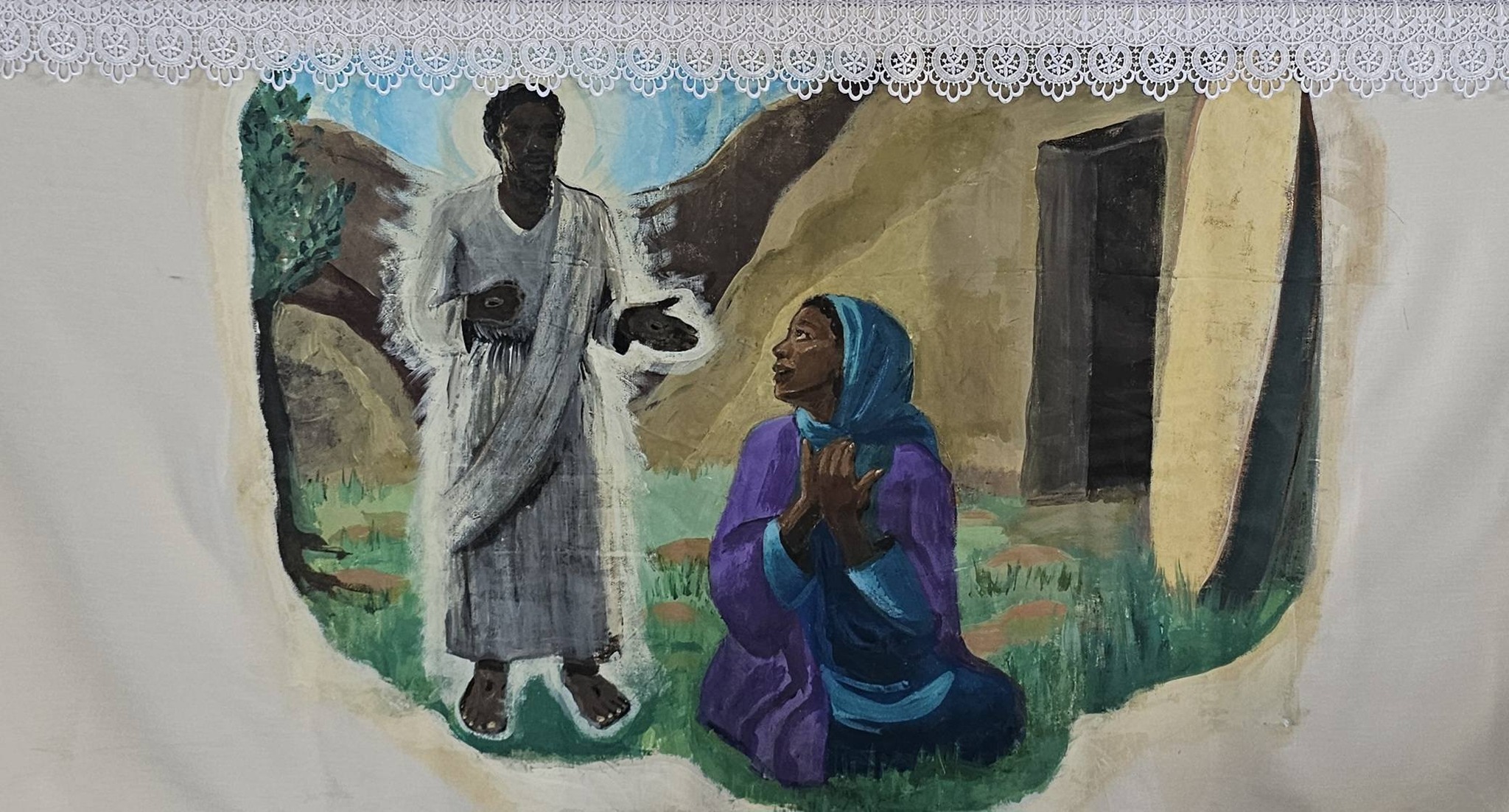
Easter - Camille Chedda

I believe very few of you would have seen the Easter altar cloth at St. Matthew’s Santa Cruz.  A picture of it is above. It was done by Camille Chedda. It is the encounter with Jesus and Mary Magdalene. Every time I look at it, my heart burns within me.  I usually describe it as being ‘strangely warmed’.  The painting says so much. Every time I look at it, I see something different, something more. I understand the encounter between Jesus and Mary a little better. It causes me to question how I am understanding my encounter with the risen lord and thus my relationship with him. 

I believe the story of the walk to Emmaus in Luke 24, calls us to examine how we meet Jesus on a day to day basis.  The story tells us that while walking home from Jerusalem after the Passover, two disciples encountered the risen Jesus. they do not at first recognize him. It is not in church, synagogue, temple or in a worship service.  this describes how many of us meet Jesus. Firstly, He appears in our lives and we do not even recognize that he is present.  secondly when we realize that he is present, we become committed to him. 

Sometimes we go through life without ever acknowledging that Jesus walks with us.  The song says he walks with me and he talks to me and he tells me I am his own and the joys we share as we tarry there, no other will ever know.  Our encounter with Jesus is personal.  No two encounters feel the same way because we are individuals, who experience things differently.  Your encounter is not mine.  i am sure many persons come and see the Altar Cloth at St. Matthew’s and admire it. But I have never heard of anyone saying they were moved by it.  It doesn’t mean that they are not moved by what it says to them, but they may not think it is important enough to share it. 

The passage says that they were blinded, they did not see that it was Jesus who had joined them.  They were not visually challenged, but like many of us they were not paying attention.  They were preoccupied with their thoughts: that they missed Jesus, that their hopes had been dashed. Jesus, I am sure did not change physically.  It is the same when the disciples saw him on the shore.  There is something about encountering Jesus, that makes us afraid to acknowledge that he is here in our lives.  For us, it is, I believe that we have been taught perfection. That there is a checklist, if all the boxes are not ticked, it means we have failed. “Jesus really could not come to someone like me”. We hear it in the songs and hymns – a sense of not being good enough for Jesus to be with us. He is too good and we are too sinful. So we go through life feeling that we are not worthy enough for Jesus to be with us. We are unable to have encounters with Jesus and for Jesus to bring meaning to our lives, so we go through the motions.  The road to Emmaus tells us pay attention. Jesus is with us all the time. He comes in the ordinary and mundane.

These disciples  were distressed about the empty tomb.  They were trying to make sense of what the women had reported.  They have been talking about it all day;  wondering I suppose how this could be. Adding and subtracting possibilities, trying to explain what could possibly have occurred.  Trying to understand what the empty tomb meant.  They wanted to understand.  They possibly reminded themselves of things Jesus said before he died. Maybe how the temple would be rebuilt in three days.   

They probably doubted the women and they certainly are disappointed by Jesus’ death.  They were depending on him to save Israel from the Romans.  They misunderstood.  Like so many of us we fit Jesus and God into what we already believe and know, rather than seeing ourselves and what happens, as being a part of a larger picture.  We do not see ourselves as being in a world we don’t quite understand and that we should be open to new perspectives leading to a deeper faith. Like the Altar Cloth and I, every time we  have an encounter, whether its through scripture, a song  a sermon or some life experience we learn something more about Jesus. 

The men (an assumption) learnt something more as Jesus explained. They opened their heart and what he said made sense.  It filled out their understanding rather than fitting into what they already understood.   They now had a fuller picture.  

They saw their encounter as being  significant enough to share. They didn’t understand it as a vision, or duppy. They understood it as Jesus walking with them and breaking bread with them. 

We too, like the disciples are called to give meaning to our encounters with Jesus in our daily to day life.  We are called to experience life through our hearts burning within us as we recognize God working in us and for us.  We do not experience this by going along with what others tell us, but being open to the movement of the spirit within us. Listening to the spirit speaking to us and following it. 

We do not believe and come to know Jesus through facts.  We come to know him when our hearts react to what is happening to us and around us. The passage says their hearts burned. This heart burn does not cause indigestion. And many of us dismiss it, because we see others going through the motions.  We sometimes think that hearing Jesus and really and truly doing Jesus’ work requires you to stop living normal lives. You must appear to others and believe yourself to be perfect.  God does not ask for perfection God asks for faithfulness.

We should not meet our encounters with skepticism and distrust, discounting them as nothing important. They are important because that is where we live and tell the Jesus story. That is when people see Jesus through us. 

The story of the walk to Emmaus, calls us to examine, how we have been treating our encounters and asks the question, if it is enough? Are our hearts strangely warmed or burning within us? If it is what are we doing about it? I don’t know if I told you the story of how I became a priest but this is what happened.

I was invited to a weekend retreat/workshop, put on by the All Together Group of the UWI Chapel, St. Margaret’s Liguanea and Church of the Ascension -Mona. Bishop Robert Wright of Atlanta was the guest speaker for the weekend. After the church service on Sunday I went to the Bishop and told him how he had inspired me. He asked “What are you going to do about it”, looking straight at me. I felt something move from the top of my head to the sole of my feet and back up again. it was like a bolt of lightning. the rest is history as they say.

OUR CHALLENGE

You may not have had as dramatic an encounter as I did, but, I do believe each of us has met the risen lord in one way or another. It is why we continue to attend church.  But friends, we must pay more than lip service.  We must actively pay attention to the heart burn and address it by making Jesus become real and alive in our lives so that others can see. We must seek to understand what is happening to us so we can explain, we can testify.  Sometimes we do not agree on how to express Jesus. We want others to be like us.  But there is no one way of Jesus showing up.  We are just called to show up as he leads.  I pray that our hearts will burn within us, that we will feel strangely warmed. I pray that we will not be afraid to do God’s bidding, even while it is painful.  May we have the faith to live as Jesus calls us and not what is convenient to us.  Amen

Posted in Religion, Uncategorized | Tagged , , , , , , | Leave a comment

John 4:1-42 The Woman at the Well – Sermon on International Women’s Day

Recording: https://youtu.be/4K6_CYSxefs?si=OjdYd63a_UATozY- 

Today we celebrate International Women’s Day (IWD). This started as protest for women’s rights in 1908. Horrible things were happening to women in the workplace all over the world. In the USA the movement got much support when the Triangle Shirtwaist Factory fire, occurred in New York City on March 25, 1911. 146 immigrant garment workers died within 18 minutes because of unsafe working conditions. The Fire broke out on the 8th floor of the Asch Building in Manhattan, spreading rapidly through a factory filled with fabric scraps. Their deaths were preventable but management had locked the doors to prevent theft and unauthorized breaks, trapping the workers. They died from smoke inhalation or jumping through the windows. Its weird because just days before, on March 19, IWD was marked for the first time in Austria, Denmark, Germany and Switzerland.

Commemorating and celebrating IWD says to our women and girls that they are of value. Their minds bodies and souls. I would like the women and girls to say with me.

Today we remind ourselves that all human beings have value and offer to the world and our community, something worth seeing, something worth hearing, something worth feeling. Today we remind ourselves that women that people have dignity, strength, and are gifted.


Our gospel reading is John chapter 4:4-42, the story of the woman at the well.

Jesus’ conversation with the Samaritan woman at the well models how God sees women: not as second class citizens, nor as problems to be fixed or persons to do the dirty work, or pick up the slack, but as complete persons, thirsty for life, worthy of honest talk, and called to be witnesses. Thus we are challenged to listen to the story and let it shape how we treat our women; let it shape how we see others who are different from ourselves; let it shape how we as women and girls see ourselves.

Women are to be respected and empowered, as equal partners, colleagues, team mates in our families, churches, workplaces, and communities. They can negotiate too. They have a say in what happens.

Let us look at the story.
Jesus was on his way home from the feast of the Passover in Jerusalem. He goes through Samaria where the Jew’s cousins live. The Samaritans are Jewish but they have intermarried with other nations. The Jews do not like the Samaritans. They treat them as if they are nobodies. They consider them unclean. They would not sit with them at the same table to eat. Jesus comes to Samaria tired. It is midday. He stops at a well and the disciples go to get food in the nearby village.

A woman comes to the well at that same time. She comes alone which is unusual for a woman. In that culture women are always accompanied by someone. But this woman comes alone, to avoid the crowd.

Why?

You see, she carries within her, something that makes her want to separate herself from society. She no longer wants to talk to people because of the pain she carries within her. We see her admitting to Jesus that she has been unfortunate in love. In any society a woman like that is scorned. What we are not told is the story behind her having 5 husbands, and living with a man who is not her husband. It sounds like a very typical Jamaican relationship. In Jamaica if you live together for 5 or more years you have the same rights as a wife. But while many Jamaicans practice living together, even those who live like this do not believe it is right. We want you to be married. It gives status. The church wants the ideal for all of us, so it too looks down on these relationships. Why she has 6 husbands we will never know and if we ask women who have more than one ‘baby father’, we would not be surprised how sad the story is.

This woman with her jar approaching Jesus represents all the women and people in our lives on whom we look down.

She represents:

  • The people we do not want to associate with because they will tarnish our good name.
  • The people who, if we are friends with them nobody would speak to us.
  • Somebody, who society says do not belong but all they can do is shun her.
  • The person who we believe cannot come to the communion table and who we believe that one day the wine will choke them.
  • The woman who is beaten by her husband and is afraid to leave him.
  • The woman whose husband says she cant have friends, nor can she be seen speaking with anyone.
  • The pregnant teenager, who parents tell their children not to be her friend because they don’t want their daughter to catch that particular disease.
  • A member of the family whose name is in the newspaper and now nobody speaks to them.
  • The girl who has had to fend for herself since she was twelve.
  • The sixteen year old girl whose father has died and her stepmother puts her out, because she can no longer look after her.
  • the young girl who has to leave home because she is old enough to find a man to look after her.
  • Melissa Silvera, whose husband was allowed to plead to a lesser charge than murder.
  • The woman who sprayed gas on the lady because that is what she had on hand to defend herself.

We are not deciding if these things are right or wrong. We are not making a judgment call. We are just highlighting bad situations, that women and girls find themselves in. The situations to which we turn a blind eye. When they come for help we pray for them but offer no assistance.

International Women’s day says we must Break the silence! Stop the violence!. It says they deserve more than prayers. They deserve the living water giving them life so they can rise from the ashes of injustice and their shame. Remember violence does not have to be physical it can be emotional. Because sometimes the things we say about people and to people hurt more than if you had taken a stick to them. We must remember that.

We Must Say No to conflicts and disagreements, no to misunderstandings.

We must say yes to talking. Yes to being honest about our feelings. Yes to listening how the other person feels. In any relationship, there must be an agreement on how you engage others. parents and children, husbands and wives. Teacher and student, brothers and sisters.

At the well, in the woman’s distress and unworthiness, Jesus meets her and listens to her. She feels comfortable and the spirit inside of him speaks to the spirit inside of her and she hears what he has to say. He knows who she is. He knows what she needs. Jesus does not pretend that there is no problem. Jesus doesn’t shame her, He meets her where she is, offering “living water.”

For women this living water is not just spiritual belonging, it is safety, dignity, being able to earn a decent wage, its about health care, reproductive rights – who owns your body, your husband or you, getting a good education or being able to make use of the opportunities we are given. These are the real challenges women face in life. Just as the woman said to Jesus I have none, our faith calls us to acknowledge the needs of others without judgment and to bring life-giving resources to them.

I have stressed women because of the day but our brothers and boys suffer just as much. The woman at the well is everybody who is ashamed of who they are. WE are called to have the compassion of Jesus. always putting ourselves in the victim’s shoes, always seeking the truth but not judging.

The woman is anyone we have shamed because of their circumstances. Her humanity is to be affirmed. Our humanity must always be affirmed. At all times we should look at others as we want others to look at us. Everybody is a somebody of importance You and I are somebodies. The children have a song, I am a promise I am a possibility. Each of us is a promise.

In this story we see the woman being redeemed. She recognizes that her past does not define her. She recognize that through what Jesus is offering, life for her will be better and can be better. She accepts Jesus’ offer. Jesus, even though he knew her story did not condemn her, instead, he offered an alternative lifestyle. Jesus’ response follows from the chapter before. John 3:16 says God so loved the world that he sent Jesus to save the world. But John 3:16 does not stand alone. Verse 17 says Jesus did not come to condemn. He came to save the woman and he is saving us now. In the story, Jesus shows, us how to live better, how to love, to be as he prayed in John 17: 21, to be one as he and the father are one. To be in one accord to be in fellowship with each other, to treat others as you want to be treated. That is what the woman at the well wanted. To be treated as being normal. It is what we want. It is what every single human beings wants – to belong to something greater than ourselves.

But you know what, as adults, as parents, as women who suffer and continue to suffer at the hands of a society which favours men, we have given up on ourselves. We have abdicated, or relinquished our responsibility to our women and girls. All must know that they are not lesser people than boys or men. They must understand that whatever the situation, no matter how hard it is, there is a way out. But that way comes through leaning on Jesus, spending time getting to know when he is speaking to you and following as he points you out of the situation.

The woman at the well was not ashamed of her need. She knew what was keeping her from participating, she knew what she needed and she asked for help. Jesus gave her what she needed.

Jesus’ action becomes our pattern for healing the brokenness inside of us. Jesus crossed boundaries to heal the woman. He was Jewish man, she a Samaritan woman, meeting at the public water source. They should not be speaking. He initiates a respectful conversation: he asks, listens, reveals truth gently. We still have women who live with being ashamed of who they are – skin colour – like our bleachers, poverty, the fact that they are tending to 40 with no husband, The gospel story challenges this. It says we, you and I must create spaces, where women’s voices can be heard, and treated with respect. WE must treat others as we want to be treated.

We cannot leave without acknowledging that we have made some progress as Jamaican Women. The World Economic Forum report of 2025 out of 148 countries ranks Jamaica #1 in educational attainment for women, due to high enrollment rates at primary, secondary, and tertiary levels. Our women outperform men in various education metrics. We are among the top 20 in the world in leadership and #8 participating in economic. Yet our women and children are still abused and ill treated. In a 2017 study Jamaica ranked second globally for the intentional killing of females. One in every four women experience physical or sexual violence in their lifetime, and nine out of every ten children experience violent discipline at home. How come? Why?

As persons who know the goodness of God’s grace, we must as Jesus did. speak truth that helps transform others. we must respond with honesty and growing faith because God’s grace works through truth-telling, not secrecy. We do not judge but we assist in seeking restoration and empowerment.

Like the woman at the well we must become witnesses. After encountering Jesus, the woman leaves her water jar and runs to tell others. she says come and see a man. Her testimony brings many to believe. We must pay attention to our women. when women lead, whole communities change. . Treat others as we want to be treated. we meet people who ever they are, where they are, we listen without judgment, we bring them into God’s life-giving truth, as we receive this living water, giving life we bring that life to others.

Today like the woman at the well Jesus is calling you and I to leave our past behind us and walk into the future with him. A future where there is no shame, where we stand tall. Where we understand that we are free to act like anybody else, free to receive what is duly ours as human beings. – respect and dignity. May we never forget that we are somebody.

Posted in Religion | Tagged , , , , , , , , , | Leave a comment

The Sermon I did not preach: Love abides in us.

This morning, I did not transfer my sermon from the laptop to the tablet for the midweek Eucharist. I preached differently after preparing what I thought was a fine word. Below is the sermon I had prepared.

Beloved, if our hearts do not condemn us, we have boldness before God; and we receive from him whatever we ask, because we obey his commandments and do what pleases him. And this is his commandment, we should believe in the name of his Son Jesus Christ and love one another, just as he has commanded us. All who obey his commandments abide in him, and he abides in them. And by this we know that he abides in us, by the Spirit that he has given us. 1 John 3:21-24

When I saw that we had a reading from John, for the Mid-week Eucharist, I got very excited. I love John’s writings. I don’t know that I spend a lot of time delving into them, but the idea of Oneness, God’s spirit being in us, warms my heart. I love the theme of Abiding in God’s Love: The Spirit Within Us. I feel complete when I think about this.

It says to me, you have been given all you need as the all-mighty all-knowing, the comforting, the healing God resides in you and me, and with you and me. I do not believe there is any thing greater than this. I do recognize that it takes time on my part to get to understand God, to know God, to be able to identify God’s voice differently from the other voices speaking, particularly my own self -doubting voice.

This passage from John speaks to that. It says we must strive to identify God’s spirit. I have heard several persons speak on what testing the spirit means, but I find none of them resonating with me. I don’t hear in what they say the voice of God speaking to me. As believers the one (God’s Spirit) living in us is greater than the spirit in the world. John calls the spirit of the world, the Antichrist. A many pronged spirit that spouts evil, injustice and discord in all the places that we allow it to breed. We should not give way to it. Throughout the ages and even today God’s spirit, God’s voice guides us to overcome the false prophets and wrong teachings.

1 John 3:21 – If our hearts do not condemn us. we have boldness before God. Once we place our hands, our minds, our hearts, souls and bodies into the hands of God, we can be transformed from our ordinariness into extra-ordinariness. We are able to do God’s work without fear. John 3:18 supports this. It says Whoever believes in him is not condemned, but whoever does not believe stands condemned already because they have not believed in the name of God’s one and only Son. We belong to God. God’s spirit is in us verse 24 says. And by this we know that he abides in us, by the Spirit that he has given us. Chapter 4:6 says We are from God.

Friends, God is with us, God is in us, we belong to God. Its not a puppy love arrangement. It is not like developing a teenage crush. It is also not like having a young adult mentor for whom you would do anything. It is not movie-star worship, or author worship. I have that relation with Danielle Steele. I buy all her books. I haven’t read them all, but just having them in my Audible library makes a difference to me. I feel complete. Weird example, but we all have relationships in which we feel complete. We feel safe in these relationships. As long as I have this, nothing else matters. That should be our relationship with God. God is the beginning and the end. God should complete us. Like good friends or a husband and wife who complete each others sentences, who know each other inside out. That should be our understanding of God.

We cannot truly know God inside and out. We are only sure of what God reveals to us. We can be assured that our father and creator knows us inside out. God knows us by name. If we listen, we can hear God calling to us. He calls us back when we are about to fall off the brink. A young girl told me on Christmas day that she was going to a paid party later that evening. I realized she was asking for my permission. She thought she should not go because she was a Christian. I cannot recall what I told her, but God does not call us to not have fun and frolic. Jesus was the life of the party. He always represented himself well in these places. Look at story of the woman anointing his feet with the oil. Just like Jesus in that story, we are called to represent ourselves with integrity. This shows that God’s love resides in us. We are to be compassionate to all.

We must strive to discern God’s love and voice as it completes us. We have no regrets as we know whatever happens it is all good. We understand that God’s love calls us to be authentic and true to ourselves, Truth is eternal, but what is true depends on what you know. So don’t go holding onto what was true yesterday in the face of the more information you get today. God’s love identifies us and we must live that identity. It empowers us to be our best godly selves pouring out God’s spirit that resides in us. Giving the love inside us to others. We must allow it to move in us and to move us to be the best.

May we seek to delve inside ourselves and our lives discerning God, being real and Christlike. Amen

Posted in Devotional | Tagged , , , , , , , , , , , , , , , | Leave a comment

The Christmas message: Grace, Light and Life

Christmas greetings to you all! It has been a long time.

Despite the many challenges we face, I sincerely pray and hope this season brings you joy and comfort.
Today, we reflect on the Christmas story as recounted by John – 1:1-18. Unlike the other Gospel writers, John does not mention angels, shepherds, Jesus by name, or even Joseph and Mary. Instead, John’s account grounds the Christmas story in creation itself.

John reminds us of the Power of the Spoken Word, that God is our source and Jesus is the light and life we all need. John calls us to practice our belief and to be transformed into who Jesus has called us to be. Who Jesus by his own life and testimony showed us how to live.

John begins with the phrase, “In the beginning was the Word.” This concept calls to mind two popular Jamaican sayings: “there is power in the tongue” and “speak it into being.” Although we might not usually associate Jesus’ coming with these phrases, they perfectly capture what happened in creation. In the beginning, God spoke and brought into existence everything we know—the world, galaxies, planets, stars, mountains, valleys, creatures, seas, rivers, day and night, sun and moon. John’s approach is deeply philosophical. He lived to a ripe old age and so had time to reflect and contemplate the mysteries of faith and life.

John offers us four important reminders about God and Jesus.

God is Our Source: Everything begins with God. John connects the events of creation to Jesus, God’s Son, who came to earth because of God’s love for the world. Jesus is the Word that spoke everything into existence. This spoken Word became flesh at Christmas, as Jesus was born and dwelt among us. Jesus—who is God—became human and lived among people. He inhaled and exhaled just like us.

Jesus is Light and Life: “Light and life to all he brings, risen with healing in his wings.” Over recent months, we have all felt the need for more light in our lives. Physical darkness is difficult to manage, and spiritual darkness is equally challenging. No solar panels, batteries or kerosene to help us. Often, we ignore or hide our emotional and spiritual struggles. Very often we are not willing to let on, that we don’t quite get it. And sometimes we want it to understand it like a math problem. But the mind and spirit walks differently.
Christmas reminds us that Jesus came to guide us; we do not need to walk in spiritual darkness. Jesus illuminates our path, teaching us how to connect with others, to live with purpose, and love—even when faced with betrayal.

Jesus gives life—abundant, boundless, and active. Each day should be lived fully and authentically, so that others see how much God and they matter to us. Jesus emphasizes that while rules are good, caring for people is most important—living with justice, mercy, humility, and love. Living with dignity, We are called to put aside unhealthy beliefs and old, outdated ways of thinking and behaving.

We are called to Believe and Be Transformed: John notes that the world did not receive Jesus when he came. Yet, we benefit from 2025 years of experience and tradition handed down to us. We are called to believe in Him, welcome Him, and allow His life-giving light to transform us and those around us.

We receive Grace Upon Grace: John reminds us that we live by grace—grace upon grace. God gives us second chances, and Jesus continually brings us back when we stray. In chapter 14, John records Jesus telling Martha, “I am the way, the truth, and the life.” Jesus is both the beginning and the way forward. He is God, the Creator, the Sustainer, and the ‘Source of the light and life’, we need to thrive. We have seen His glory through the miracles He works in our lives.


Embracing Jesus This Christmas

This Christmas, let us once again embrace Jesus, allowing His light and life to fill our hearts and guide our lives.

  • Let us choose the healing that Jesus brings us. Let us choose the exciting abundant life Jesus shows us with all its heartaches.
  • Let us choose to walk in the light that dispels every darkness, trusting that with Jesus, every new day is an opportunity for hope and renewal. As we gather this season, let us open our hearts to the transformative power of God’s love. Remember, just as God’s Word spoke creation into being, so too can our words and actions speak life, encouragement, and peace to those around us.
  • Let us participate in the miracle of Christ’s birth by being compassionate, by making space for joy and healing, and by choosing kindness instead of turning away. New mercies each returning day hover around us while we pray. Each day a fresh chance to reflect the love and light of Christ in a world longing for hope. Let us commit to nurturing faith in ourselves and in others, working God’s grace by restoring relationships, forgiving others.

May we carry the message of John in our hearts: God is our source, Jesus is our light and life, we are called to believe and be transformed, and we live in the assurance of grace upon grace. May these truths shape not just our words, but our lives, and may we to shine light and life to others, reflecting the glory of the One who dwells among us. Amen.

Posted in Musings, Religion | Tagged , , , , , , , , , , , | Leave a comment

A prayer

Breathe in me, O Holy Spirit,
That my thoughts may all be holy.
Act in me, O Holy Spirit,
That my work, too, may be holy.
Draw my heart, O Holy Spirit,
That I love but what is holy.
Strengthen me, O Holy Spirit,
To defend all that is holy.
Guard me, then, O Holy Spirit,
That I always may be holy. Amen
- St. Augustine (354-430)
Posted in Uncategorized | Leave a comment